
Pasture gives a horse or a cow a steady supply of ALA omega-3, an essential fat the animal cannot make for itself. Hay and grain don’t. Most animals spend most of the year on a diet that leaves that fat out, and the first signs show up in the coat, the hooves, the body condition, and how fast they bounce back. This post covers the gap, what puts the fat back, what owners are seeing, and what the research does and doesn’t prove.
The ALA Omega-3 Gap in Hay-and-Grain Diets
Horses, cattle, and dogs cannot make ALA. It has to come from the diet. Equine nutritionist Dr. Juliet Getty puts warm-season grass at about 10 mg of ALA to 2.5 mg of omega-6 linoleic acid per gram of dry matter, a 4:1 ratio. Hay, she notes, no longer carries appreciable levels, and most commercial feeds flip the ratio toward omega-6.
The two fat families compete for the same enzymes, so a diet heavy in omega-6 and empty of ALA is not neutral. A horse on hay and grain in January is eating a diet that never sees the fat his body evolved on, which is part of why winter horse nutrition and winter cattle nutrition take more than hay.
What Cold-Milled Flax Puts Back
Flax is the richest plant source of ALA, but only if the ALA survives processing. Cold-milling slices the seed open with an impeller. No friction, no heat, no oxidation trigger, so the ALA omega-3 arrives intact, at a guaranteed minimum of 12% omega-3 (ALA). Wondering why not just pour oil on the feed? We cover that in flax vs oil.
Then there’s the second half. Outlaw pairs the flax with a proprietary microbial fermentation ingredient that supports native gut flora. University trials show improved nutrient digestibility and rumen bacteria counts. The fat gets put back, and the gut is set up to use the feed it’s already eating.
What Owners Are Seeing
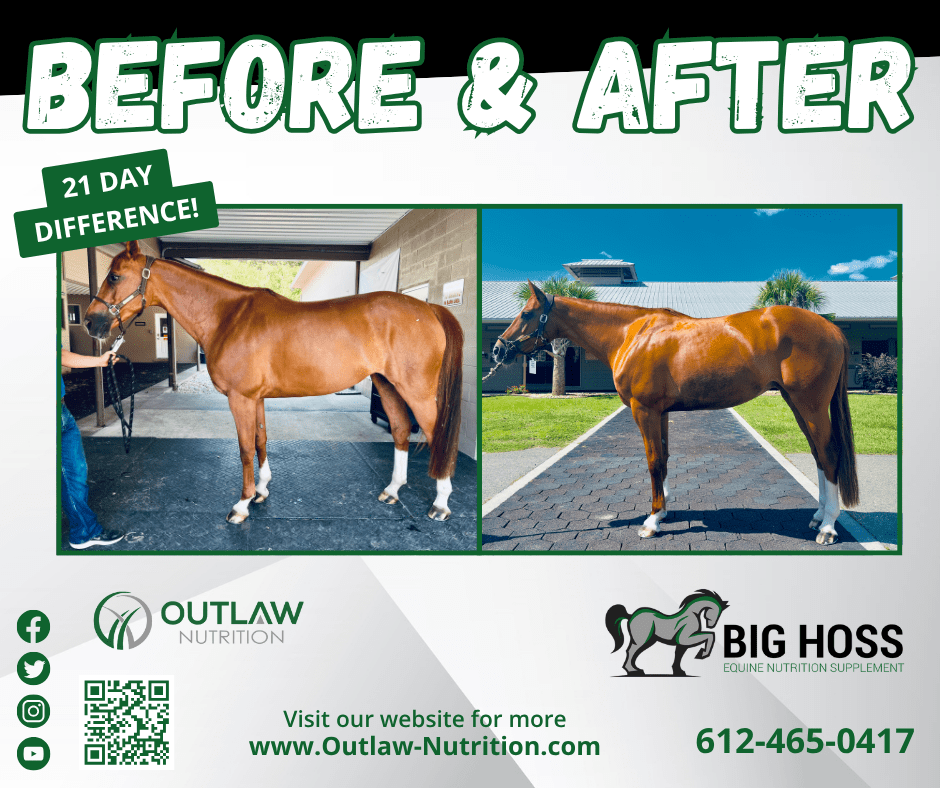
Horses. Madisyn H. switched her thoroughbred, Texas Toast, to Big Hoss and reports cutting grain from 15 pounds to 6 pounds a day while dropping her other supplements. She says her feed costs fell by nearly half, and that his joints, muscle recovery, and coat all improved.
Cattle. Flogstad Farms started Stocked Up on their 4-H cattle and reports softer, shinier coats and more than 100 pounds of gain per animal in a month.
Dogs. Crystal M. says the double coats on her Huskies are “healthy, thick, and SOFT” on Unleashed, and that shedding season got easier.
These are customer reports, not trials, and results vary. You can see the before-and-after photos and read more on our customer testimonials page.
What the Research Does and Doesn’t Say
Flax is not fish oil. Mares fed flaxseed meal showed no EPA or DHA in their blood, while mares fed marine omega-3s did (Hess et al., 2012), and dogs fed flaxseed raised EPA but not DHA (Bauer et al., 2010). If your animal needs preformed DHA, that is a different ingredient. The case for flax rests on ALA omega-3 itself (more in our guide to flax for horses): six horses with a midge-bite allergy showed a smaller skin-test reaction after 42 days on crushed flaxseed (O’Neill et al., 2002), a small pilot but a real effect. Cattle are the exception to the tissue story, since rumen microbes hydrogenate much of the ALA. Their case rests on outcomes and gut function, like Kansas State’s stressed-calf work, where flaxseed partly blunted the inflammatory response and raised feed intake.
Start Closing the Gap
Big Hoss and Stocked Up are fed 1/2 cup per 350 pounds of body weight per day. Unleashed is 1 tablespoon daily for a 40- to 60-pound dog. Smaller dogs get less, and bigger dogs get more. All three take about four to six weeks to show results, so start early, at least a month ahead of a stress period like winter. Questions? Call 612.465.0417.
When you need what’s required… Outlaw Nutrition.
FAQ
Can horses and dogs turn the ALA in flax into EPA and DHA?
Only to a limited degree. In research, mares fed flaxseed meal showed no EPA or DHA in their blood, and dogs fed flaxseed raised EPA but not DHA. Flax works as an essential-fat source, not a fish-oil replacement.
Why does ALA matter if conversion is low?
Horses, cattle, and dogs cannot make ALA, so it has to come from the diet. Pasture supplies it. Hay and most grain-based feeds supply little and tilt the diet toward omega-6.
Does ALA from flax reach cattle tissue?
Rumen microbes hydrogenate much of the ALA before it is absorbed. For cattle, the case for flax rests on research outcomes and gut function, not on a simple tissue-delivery story.
How much Big Hoss, Stocked Up, or Unleashed should I feed?
Big Hoss and Stocked Up are fed at 1/2 cup per 350 pounds of body weight per day. Unleashed is 1 tablespoon daily for a 40 to 60-pound dog. Smaller dogs get less and bigger dogs get more.
How long does it take to see results?
All three products take about four to six weeks to show results. Start at least a month before a stress period like winter.