
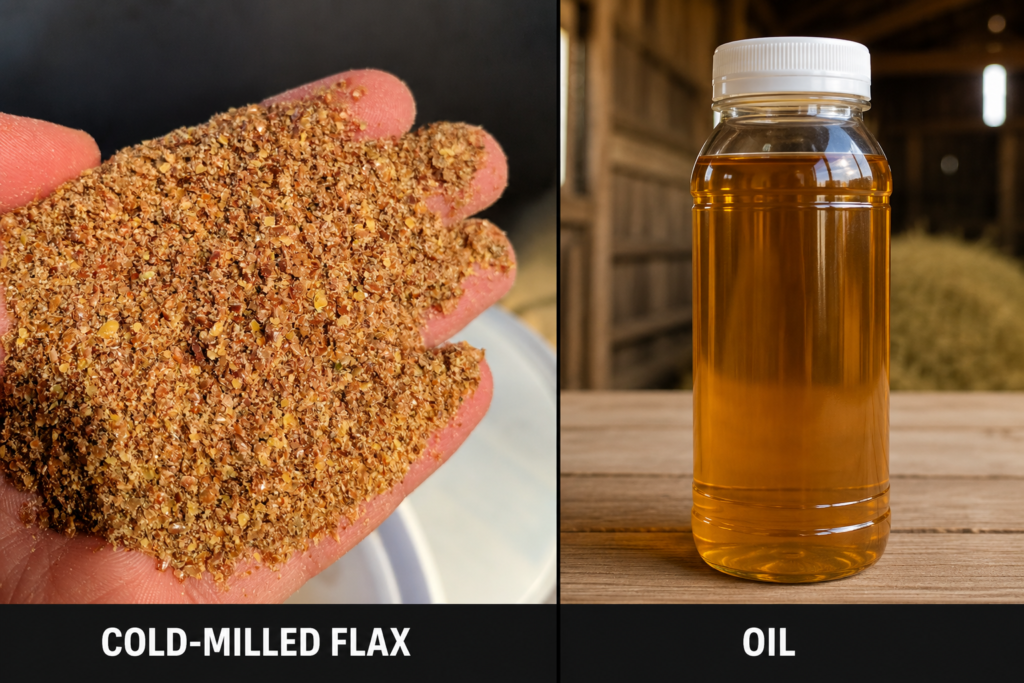
Pour oil into a feed pan, and you’ve added one thing: fat. That’s it. No fiber, no protein boost, no gut support — just calories in a bottle that started going bad the moment you opened it. If you’re supplementing for performance, recovery, weight, or condition, “just add oil” is the shortcut that skips the part that actually matters. Here’s the real breakdown of flax vs oil — corn, soy, canola, or fish — and why Big Hoss, Stocked Up, and Unleashed do a job that no bottle on the shelf can match.
The Flax vs Oil Omega Ratio Problem
Walk down the supplement aisle and “oil” almost always means corn or soybean oil. Both are loaded with omega-6 fatty acids relative to omega-3 — soybean oil runs about 7:1 in favor of omega-6, corn oil is worse at roughly 56:1. Since most diets are already omega-6 heavy, pouring on more just tips the scale further toward inflammation. Cold-milled flax runs the opposite direction, closer to 0.2:1 in favor of omega-3. You’re not adding fuel to the fire — you’re correcting it. (Ohio State University Extension notes typical equine diets run under 10:1 omega-6 to omega-3, and that grain-based ingredients push that ratio higher — exactly the imbalance cold-milled flax corrects.)
Flax vs Oil: Which One Actually Stays Fresh?
All liquid oil is vulnerable to this problem — corn, soy, canola, sunflower, flax, doesn’t matter. High polyunsaturated fat content means high susceptibility to oxidation, and once a bottle’s opened, the clock starts. Most commercial oils are rated for 6 months to a year, and a lot of that shelf life comes from synthetic antioxidants added during processing to slow the oxidation down, not because the oil is naturally stable. Our cold-milling process doesn’t need that crutch. Our process slices the seed via impeller — no friction, no heat, no oxidation trigger — and the result is a product with a full 2-year shelf life when stored properly, no stabilizers or preservatives required. No refrigeration, no bottle going bad in your feed room halfway through the season.
Oil Is Fat. Cold-Milled Flax Is Everything Else, Too.
Oil is 100% fat — nothing else survives the extraction. Cold-milling keeps the fiber, protein, and lignans intact along with the fat, because slicing the seed doesn’t strip anything the way pressing for oil does. That fiber includes soluble mucilage that supports healthy gut transit, something a bottle of oil simply can’t offer. When you feed oil, you’re buying one nutrient. When you feed cold-milled flax, you’re buying four.

Chasing Weight and Bloom? Oil Only Gets You Halfway.
A lot of people reach for oil for one reason: they want to put weight on an animal and get that bloom — the shine, the fill, the finished look — into their coat and condition. Oil can add calories, no argument there. But calories alone don’t build condition; what the animal actually digests and absorbs does. Research out of North Dakota State found flax-fed cattle gained an extra third of a pound per head per day compared to unsupplemented animals — real evidence that flax’s energy density does the job oil is being asked to do. Big Hoss and Stocked Up take it a step further: the same energy-dense flax paired with a fermentation ingredient shown in university trials to improve nutrient digestibility means more of what’s fed actually gets used, not just passed through. That’s the difference between an animal that looks fed and one that’s actually thriving.
The results speak for themselves — 21 days on Big Hoss and the difference in topline, fill, and overall condition is visible, not theoretical.
Skip the Fish Oil
Fish oil gets omega-3 credit, and fairly — but it comes with a reputation for being unpalatable, and it’s asking a herbivore’s gut to process a marine fat source it was never built to handle. It doesn’t have to be that way. Dairy operations have proven the swap works at scale: one Idaho nutritionist moved roughly 70,000 cows off fish meal and onto flax as their omega-3 source, reporting no drop in reproductive or health performance — and cutting about $250 per ton off the ration cost in the process. Flax gets the omega-3 job done without the fish.
What’s Leaching Into That Bottle
Here’s one most people never think about: the container. Peer-reviewed research on oils stored in plastic has found they can pick up microplastic particles over time, especially with heat and extended storage — enough that regulators use oil as the standard test material for measuring how much plastic migrates into fatty foods. That research is on food-grade corn, soybean, canola, and similar oils — the same commodity oils that end up in animal feed, often from the same supply chain. We don’t have a study measuring health outcomes in horses, cattle, or dogs from this exposure specifically, so we won’t claim proven harm — but the oil itself isn’t different just because it’s headed to a feed room instead of a kitchen. A shelf-stable milled product sitting in a feed bin doesn’t carry that same slow-leach risk at all, because there’s no liquid sitting in plastic for months absorbing it.
The Flax vs Oil Difference No Bottle Can Touch
Big Hoss, Stocked Up, and Unleashed pair cold-milled flax with a proprietary microbial fermentation ingredient that supports the animal’s native gut flora. It’s non-viable — not a live probiotic — and stable for 18–24 months on the shelf. University trials behind this technology have shown measurable increases in rumen bacteria populations and improved digestibility of protein and fiber. No oil, plant or fish, does anything for gut flora. This is the difference between adding fat and building a functioning system.
Big Hoss: Built for the Working Horse
Big Hoss delivers cold-milled flax at a minimum 12% omega-3 (ALA) alongside the fermentation ingredient, supporting joint health, cooldown time, muscle recovery, and real condition — without the rancidity risk of a bottle in the tack room.
Stocked Up: Built for the Herd
Stocked Up brings the same combination to cattle, goats, sheep, and beyond — rumen health, feed efficiency, and better weight gain through actual digestibility improvements, not just added calories.
Unleashed: Built for the Working Dog
Unleashed applies the same science to canine nutrition — joint comfort, coat condition, and energy for dogs that work as hard as anything on the operation.
Ready to Cut the Oil Bottle Out of Your Feed Room?
That’s the real flax vs oil difference: absorption over addition. Check out Big Hoss, Stocked Up, or Unleashed, and see what real customers are saying on our testimonials page.
When you need what’s required… Outlaw Nutrition.
FAQs:
Is oil better than cold-milled flax for putting weight on an animal?
Oil adds calories, but cold-milled flax delivers comparable energy density plus fiber and protein — and in Big Hoss and Stocked Up, a fermentation ingredient shown to improve nutrient digestibility, meaning more of what’s fed is actually absorbed rather than passed through.
Is flax oil the only oil that goes rancid quickly?
No — all high-polyunsaturated oils, including corn, soy, canola, and sunflower, are vulnerable to oxidation once opened. Many rely on synthetic antioxidants to hit their stated shelf life. Cold-milled flax stays stable through natural antioxidants alone, with no additives needed, and carries a 2-year shelf life.
Why is corn or soybean oil not a good omega-3 source?
Both are heavily skewed toward omega-6 fatty acids (soybean oil ~7:1, corn oil ~56:1 omega-6 to omega-3), which can work against an already omega-6-heavy diet instead of correcting the balance.
Is fish oil a good alternative to flax for omega-3s?
Fish oil provides omega-3s but is often poorly accepted by herbivores and comes with palatability complaints. Flax has been used to successfully replace fish meal as an omega-3 source in large-scale livestock operations.
Can microplastics get into oil stored in plastic bottles?
Research on oils stored in plastic containers — including the same commodity corn, soybean, and canola oils used in animal feed — has found they can pick up microplastic particles over time, particularly with heat and extended storage. A shelf-stable cold-milled product avoids that risk entirely.