
Most livestock nutrition content stops at cattle. If you’re raising bison, farming deer or elk, or running any exotic livestock operation the mainstream feed industry doesn’t bother writing about, you already know this. Your animals aren’t a footnote — they just don’t get treated like the athletes they are. Here’s what actually applies to them, and where we’re being straight with you about what we don’t yet have data on.
Bison: Protecting an Advantage They Already Have
Bison carry a naturally better fatty acid profile than conventional beef — pasture-raised bison typically runs an omega-3 to omega-6 ratio around 1:3 to 1:5, compared to 1:7 to 1:20 in grain-finished cattle. That’s a real, documented advantage rooted in their grazing physiology. The catch: the more a bison operation shifts toward grain-heavy finishing rations to hit weight targets faster, the more that advantage erodes — the same omega-6 dominance problem that shows up in every grain-forward diet, cattle included.
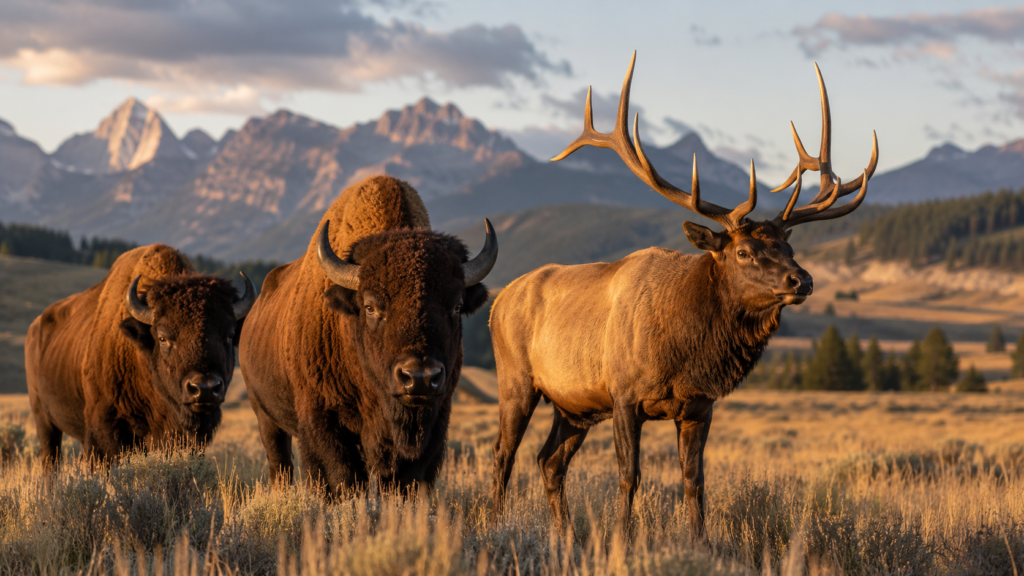
This is where Stocked Up’s role is straightforward rather than dramatic: cold-milled flax helps maintain that omega-3 advantage through a finishing period, without asking you to sacrifice the energy density you need for weight gain. At 25% guaranteed minimum crude fat — running above 30% in the actual formulation — you’re getting real energy density from a source that doesn’t fight the fatty acid profile you’re trying to protect. Fat also digests into roughly 2.25 times more usable energy per unit than an equivalent amount of grain-based carbohydrate, which matters directly for bison finishing on pasture-based systems where you’re not leaning as hard on corn to begin with.
Deer & Elk: Antler Is Bone, Not Horn — and That Changes the Nutrition
This is worth understanding precisely, because most mineral products in this space get it half right. Horn — cattle, bison, goats, sheep — is permanent keratin over a bone core, built almost entirely from protein. Antler is different. It’s true bone, regrown every year, and roughly a third of a hardened antler’s weight is calcium and phosphorus. During peak growth, bucks and bulls, roughly a third of a hardened antler’s weight is calcium and phosphorus, mobilized directly out of their own skeleton if diet doesn’t keep pace — then have to replenish those reserves afterward, on top of everything else their body needs.
Both of those growth demands run into the same bottleneck: an animal can only build with what it actually absorbs, not just what’s in the bowl. Stocked Up’s proprietary microbial fermentation ingredient supports native gut flora and improves digestibility of the nutrients already in the diet — protein included, which is exactly what horn growth runs on. Add in Stocked Up’s calcium and phosphorus, the same correction applied to flax’s naturally phosphorus-heavy profile in Big Hoss, along with a protein source that outperforms straight cereal-grain diets on lysine, and you’ve got both halves of the equation covered: the minerals and protein that horn and antler growth actually require, and a gut better equipped to put them to use instead of losing them along the way.
There’s a second window worth knowing about: post-rut recovery. Bucks and bulls come out of the rut having burned through body condition fast, running on inflammation and depleted reserves right when they need to rebuild before winter. That’s the same recovery-and-inflammation logic behind everything else Outlaw does for performance and working animals — omega-3s support the anti-inflammatory environment that recovery actually depends on, whether that’s a horse cooling down after competition or a buck rebuilding condition after breeding season.
The One Thing Almost No Competing Product Can Say
Stocked Up carries no added copper. In this world, that’s not a minor detail — most generic livestock mineral formulations carry copper levels calibrated for cattle, and those same levels can be a real problem for sheep and several camelid and exotic species sharing pasture or feed programs. If you’re running a diversified operation that includes exotic livestock, that single formulation choice means one product can responsibly cross more of your species list than a cattle-first supplement ever could.
What We’re Not Going to Pretend We Know About Exotic Livestock
We don’t have a bison or elk feeding trial. Nobody does, really — this is a research gap across the entire specialty and exotic livestock world, not something unique to us. What we do have is the same fatty acid and mineral science that holds up across every mammal we’ve looked at, applied honestly rather than dressed up as something it isn’t. If you’re raising something specific and want to talk through whether Stocked Up makes sense for your operation, call us at 612.465.0417. We’ll give you a straight answer, not a sales pitch dressed as science.
Explore Stocked Up or see what producers across species are saying at the Outlaw Nutrition reviews page.
When you need what’s required… Outlaw Nutrition.
FAQ:
Is antler growth really different from horn growth nutritionally? Yes. Horn is permanent keratin over bone, built from protein. Antler is true bone regrown annually, requiring heavy calcium and phosphorus mobilization during the growth window — a different mineral demand than horn-growing species, though both depend on the animal actually absorbing what it eats.
Does Stocked Up have research specific to bison or elk? Not yet — that trial doesn’t exist industry-wide. What Stocked Up offers is the same fatty acid, mineral, and gut-health science documented across other mammals, applied honestly without overstating species-specific proof.
Why does “no added copper” matter for exotic and diversified operations? Many standard livestock mineral formulations carry copper levels safe for cattle but risky for sheep and several camelid and exotic livestock species. A copper-free base lets one product responsibly serve a more diverse species list.